They lift your spirits, prompt you to think, make you feel grateful and inspire you to do more. They connect you to our community, shining a spotlight on what's good about our city. They're stories that are Uniquely Milwaukee.
“Everybody should experience flying, there is an ease that happens. It’s amazing the physics that has to happen, the faith. It’s just blissful.”
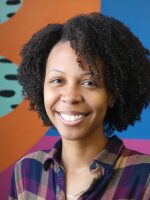
Valencia Caldwell is on a mission to fly — one led by faith, family and connection. Because even when she was little, her dad knew she wanted to be a pilot.
“Even in college, I remember my dad being like, ‘You know, you’re still talking about it. There’s a pilot that lives right across the street from Aunt Fran,’” Caldwell said. “He was like, ‘If you’ve got questions.’ But he needed me to guide that, and I wasn’t in that place yet.”
Her father, Terrance, worked as an air-traffic controller. And before 9/11, he would sometimes take her and her siblings up into the control towers for a 360-degree view.
“I don’t know why he opened it up to us. I think he wanted us to know that we always had choices,” she said. “I had to do a lot of peeling back trying to understand, relearn and question. And I think a lot of it was my dad pushing me into going after what I wanted.”
She ultimately pursued education, teaching middle-school math for 11 years and then serving in leadership to support math and special education. When her father passed in 2019, she lost her footing.

“I just kept finding myself back in the parking lots of Timmerman Airport,” Caldwell said, referring to the aviation hub on Milwaukee’s northwest side. “It was just a place where I knew we had that interaction, and he was always surrounding me. And I was really just trying to find joy again.”
As she worked through her grief, that soft pull toward aviation became stronger. During a discovery flight for her birthday, a chat with the instructor helped turn a spark into a flame.
“I was asking so many questions,” Caldwell recalled, “and he was like, ‘What made you go up at 6 o’clock in the morning?’” She gave a pat answer about wanting to see the sunrise, only to have the instructor point out that she talked about flying like someone who wanted to do it. “I was like, ‘I think I’m too old.’ He was like, ‘No, you’re not.’”
In the past, that doubt and uncertainty had gotten in the way of pursuing her dream. But she decided to set them aside and begin her years-long journey to become a pilot.
“I knew that one of the biggest statistics was that pilots quit because they ran out of funding,” she said. “So because of that I was like, ‘I’m about to work the next three years to save up my teaching salary,’ which I did — until I was laid off.”
That happened a year into her leadership role, perhaps proof that life has its own ideas about timing. In 2024, she started teaching STEM at STARBASE — a U.S. Department of Defense program at Milwaukee Public Schools that taught aviation through science, technology, engineering, art and math. From there, her colleagues encouraged her to attend an aviation festival.
“While at the EAA [Fly-In], there were a bunch of different booths. I was going to the Women in Aviation event, and right out there were booths for the Ninety-Nines,” she said, referring to an international organization of women pilots. “I had gone to the Ninety-Nines booth, and the president was there. I was telling her that I was interested in becoming a Ninety-Nine, but I didn’t know what that looked like. She told me everything that I needed.”
The U.S. Bureau of Labor and Statistics estimates there are 213,000 aircraft pilots and engineers in the country. Just 4% are African American. And organizations like Sisters of the Skies estimate there are fewer than 200 Black women professional pilots in the United States.
“There are so many opportunities in aviation, agriculture. They have rescue teams, medical teams,” Caldwell said. “There is not really an industry that doesn’t use aviation to some degree.”

Despite so many touch points, there can be many barriers to entry for anyone, including education and funding. “During that discovery flight, I learned how expensive it was. I had learned some of the statistics behind it,” she said. “Quite frankly, there’s not a lot of women in general. Growing up, I think I met one Black woman (pilot). What I knew about piloting is that you had to go to the Air Force or go into the military to be a pilot.”
Caldwell was accepted into the United Aviate Academy, an intensive flight school through United Airlines. The company’s goal is to train 5,000 new pilots by 2030, with at least half being women or people of color. She’s working to cover costs for the 14-month program and can’t start until she has proof of funds. So she’s tapping into her community for help.
“How can people help? They can like, they can share, they can donate,” Caldwell began. “But, more than anything, I think it’s just being able to be advocates in this industry and recognizing how difficult it is. That financial burden should not be the challenge that keeps people from sharing their gifts.”
Now, with her goals within reach, Caldwell is leaning into the love that has always surrounded her.
“I have a poster in my room that’s called Faith in Flight because it’s the opportunity that I’m taking the steps,” she said. “I remember being a little girl, not being able to understand how I was going to make this happen. I think that’s my reminder right now — talking to my inner child, just being like, ‘No, we got this.’ I know it’s hard, but she wants this, and she deserves this.